Never Pay for Coaching Again.
Three highly personalized AI coaches.
One payment of $97.
On-demand coaching, 24/7. No subscription.
Introductory price. Price goes up November 1.
Get All ThreeWhat in the world have you done? You are a brilliant genius. I've already used Build My Coach and it helped me have a much more successful day today.
I spent probably close to an hour last night feeding it information and answering questions and oh my gosh it is astounding to me. I also stayed in conversation a few times during the day when issues popped up.
You way undercharged for this tool. I would've paid many times over for this kind of result.
The moments you need a coach rarely line up with the moments you have access to one.Until now.
You don't usually need coaching three days later on a scheduled call.
You need it when you're talking yourself out of the thing you said you wanted. When you're stuck. When you're about to make the same choice you always make.
Now your coach is there for that moment.
You shouldn't need a bigger coaching budget to get more personalized coaching.
For $97, I'm giving you access to three different AI coaching experiences, each built to deliver a level of specificity and personalization that generic AI can't touch.
You know what you want to do. Then the moment comes when doing something else feels easier, deserved or justified. This one finds where your follow-through keeps breaking and helps you build something specific for those moments.
A coach that learns your patterns, your excuses, what works for you and what never has. It should know you better three months from now than the day you build it.
Bring me the problem directly. Trained on 2,000+ podcast episodes, books, programs and frameworks to answer you the way I would.
Here's what you're getting:
Defense Lab
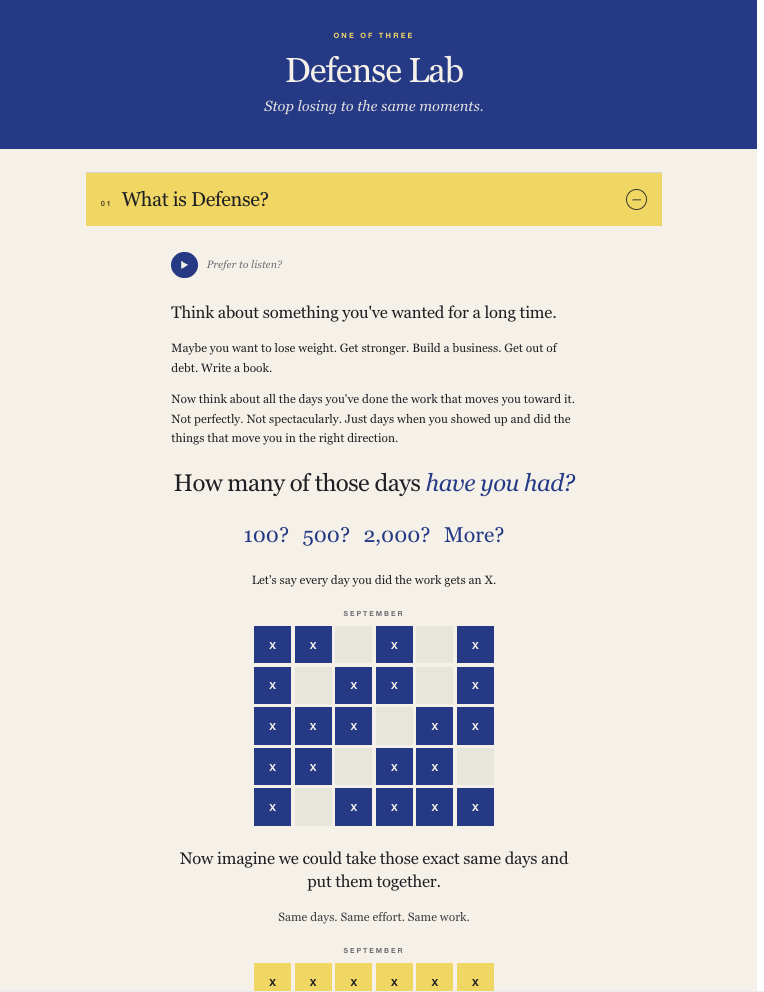
Stop losing to the same moments.
Defense Lab is built specifically for those moments.
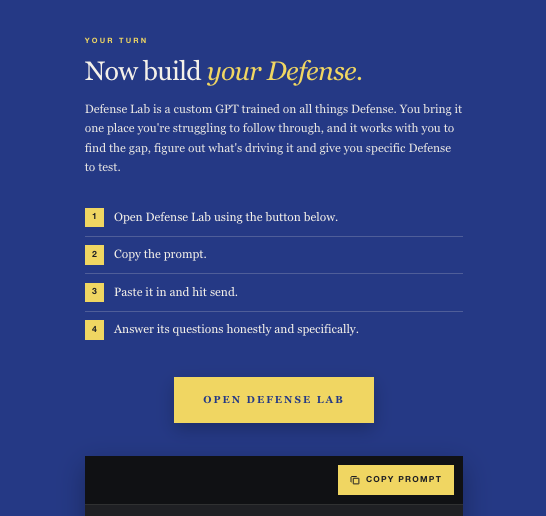
You'll start with a personal Defense assessment that interviews you about where you're struggling to follow through, what actually happens when you don't, and what may be driving the pattern even if you can't see it yourself.
Then you'll bring your specific struggle into Defense Lab, an AI coach extensively trained in DEFENSE, to help you understand what's happening and build something specific to test.
This isn't another plan for the days when everything goes right.
It's Defense for the moments that usually take you out.
Your Personal Coach
A coach built around you.
The more personalized coaching becomes, the more expensive it usually gets.
Not this time.
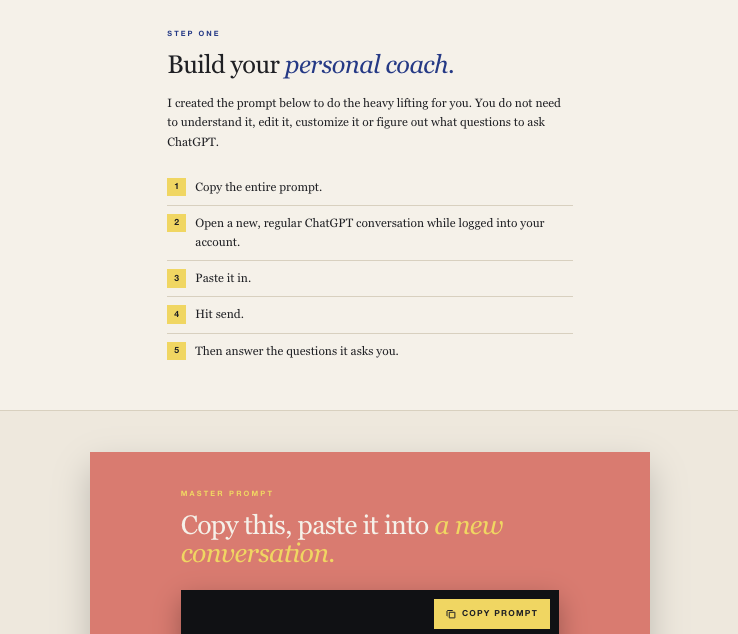
I'm going to show you exactly how to build a personal AI coach that learns you.
This isn't about opening ChatGPT, asking a question and getting a perfectly reasonable answer it could have given anyone.
You're going to deliberately teach your coach who you are.
And it doesn't just learn you once. The more it learns about you, the better it gets at coaching you.
Keep using it. Keep giving it context. Keep letting it see what happens when things work, when they don't, when your circumstances change and when you discover something new about yourself.
Your coach should know you better three months from now than it does the day you build it.
And whenever you need it? It's right there.
EBGPT
13+ years of my coaching. At your fingertips 24/7.
I've spent more than 13 years coaching people through change.
I've recorded more than 2,000 podcast episodes. Written books. Built programs. Taught workshops. Developed frameworks. And coached thousands of people through the messy reality of knowing what they want and struggling to consistently do what it takes to get there.
I've taken that entire body of work and used it to build EBGPT, a custom AI coach trained on how I think, teach and coach, designed to respond to your questions and struggles the way I would.
It's designed to coach you the way I would if you brought the problem directly to me.
And it's available whenever you need it.
What the first buyers are saying.
"Revolutionary."
The Build My Coach program with ChatGPT is revolutionary. I feel like I've accomplished more in two days with a tailored AI than I have in 6 months of group coaching with a different program.
"I was on the fence."
Initially I was on the fence about buying it. Within the first hour of using it, I realized it's going to be a fabulous tool in my toolbox, because I'm allowing myself to open up the way I have never opened up to anybody else. I've gained such insight already into my nighttime eating.
"Once you see it, you can't unsee it."
I've only been through the first segment so far, and I used it to look at two different goals that have been a challenge for me. The feedback was beyond any words I can think of. It already shifted something into full view that I had been using excuses to walk right by.
"Now I have an amazing coach."
I used the voice option in ChatGPT so I could explain better without shortening. It asked me so many questions for clarity. It even explained when I would want to use the Defense tool and when I'd want the coach. So happy with this!
"The best $97 I've ever spent."
I have to say I'm LOVING the Build My Coach program. WOW! It's the best $97 I've ever spent!
Swipe for more →
This is what $97 gets you.
Defense Lab
A highly specialized AI coach trained in DEFENSE, plus a personalized assessment designed to identify your most immediate Defense opportunity and help you build Defense for the moments when your follow-through is most vulnerable.
Your Personal Coach
A process for building an AI coach around you, including your goals, circumstances, patterns, motivations, vulnerabilities, excuses and history, that continues getting better at coaching you as it learns more.
EBGPT
A custom AI coach built from 13+ years of my work, including more than 2,000 podcast episodes, books, programs, frameworks and thousands of coaching conversations.
Available 24/7.
No subscription. $97. Once.
Introductory price. Price goes up November 1.
"You way undercharged for this tool. I would've paid many times over for this kind of result."
Questions people are asking.
What if I barely use AI?
Perfectly fine.
You do not need to know how to write prompts, understand AI, or already be using ChatGPT for everything under the sun.
I'll give you exactly what you need and show you exactly what to do.
For your personal coach, you'll get the prompt I've built to guide the entire process. It will interview you one question at a time, learn how you operate, reflect back what it understands, let you correct it, and help you start using what it learned.
Defense Lab will guide you through its process too.
You don't need to be good at AI to get exceptional coaching from it.
What if I already use ChatGPT all the time?
Then you may be even more surprised by the difference.
This isn't about teaching you clever prompts or showing you features you already know exist.
It's about taking something incredibly powerful and making it deeply personal.
You're not paying $97 for access to AI. You're paying for everything I've built to turn it into three coaches designed to do far more than generic ChatGPT can do out of the box.
Not an AI that knows what you typed five seconds ago.
We're not just going to ask AI better questions. We're going to make AI exceptionally good at coaching you.
Do I need a paid ChatGPT subscription?
No, but I'd recommend the lowest paid tier.
You can absolutely use all three coaches with a free ChatGPT account. The free account just limits how much you can use it.
For the best results, you'd want to be on the lowest ChatGPT subscription tier.
I already use EBGPT. Is this different?
If you love EBGPT, this is 10x that.
EBGPT is one of the three coaches. The other two are completely different.
One is built purely around the Defense framework, the Defense playbook and Defense coaching implementation.
The third is built purely around knowing you. It wants to know who it's coaching. Your patterns, your struggles and your setbacks.
How long does the subscription last?
It isn't a subscription.
You pay $97 one time and you're in with full access.
Take a peek inside.
Never Pay for Coaching Again.
You don't need another program you forget to finish.
You don't need more information sitting in a portal somewhere.
You need somewhere to bring your actual problem when it's actually happening.
That's what I'm giving you.
Defense when you're struggling to follow through.
A coach that increasingly knows you.
And access to the way I coach whenever you want it.
On-demand coaching whenever you need it. No subscription.
"I've been using Build My Coach for just a few hours and those few hours have been worth the cost already!!
I'm impressed and grateful to you for building such a wonderful tool Elizabeth!"
Introductory price. Price goes up November 1.
Get All Three